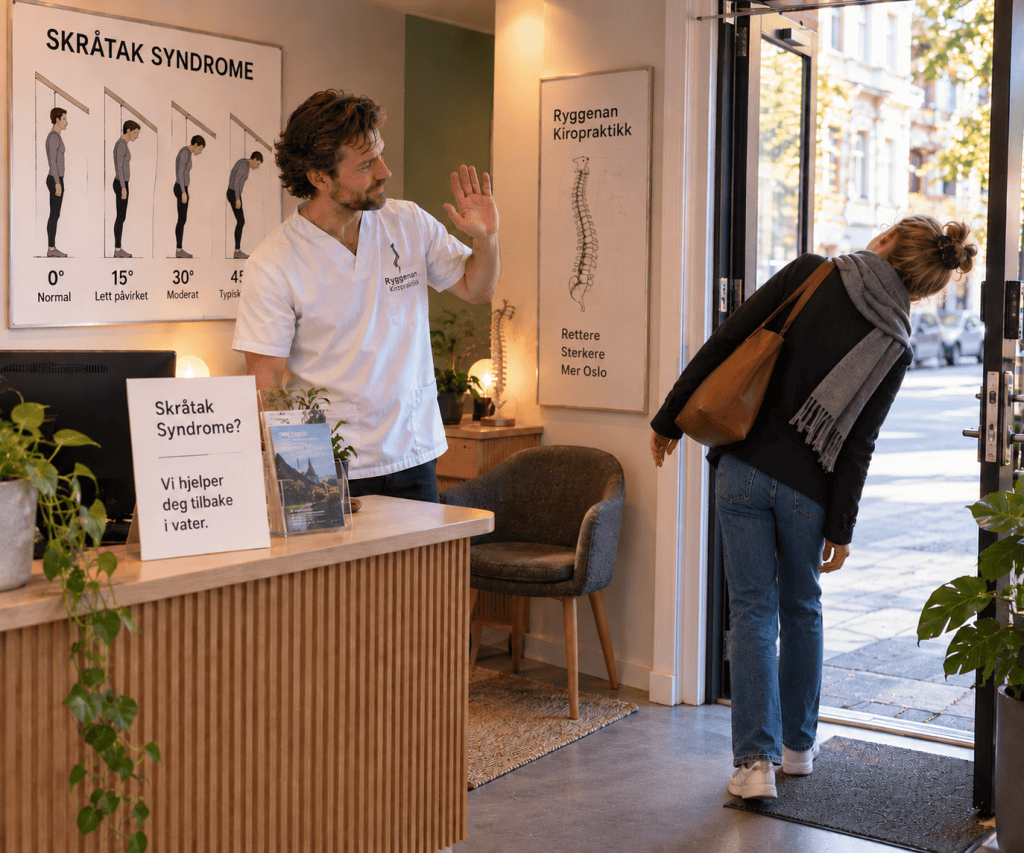
Bendik Ryggenan waves goodbye to one of his patients. The patient’s body waves back by default.Illustration: AI-generated by humanity’s future overlords.
Kjell Kaldager
OSLO—Chiropractor Bendik Ryggenan had just finished with his 20th and final patient of the day when JantePosten arrived at his clinic. The patient, a woman in her 20s, left the treatment room bent at the angle of a grandmother on her way to lunch at the nursing home.
“Forsiktig,” Ryggenan said, guiding her toward the door. “Snu.” After a series of rotations normally reserved for delivering an IKEA wardrobe to a kolonihage cabin, she finally made it out.
“She is one of many,” said a visibly exhausted Ryggenan, sinking into a seaweed-green armchair in the waiting room. Skråtak syndrome, named after the sloped ceilings common in Oslo’s loft apartments, occurs when residents’ bodies gradually adopt the angle of their ceiling.
“The human body is remarkable. Put it in an unnatural environment and it adapts,” Ryggenan explained. “But the cars we drive and the offices we work in do not.”
Ryggenan admits the alarm has been good for business, and for the reputation of a profession he describes as “a shaman, but for gentlemen.”
Not everyone sees the condition as a problem. Runi Regnep, who runs a bunad shop in Oslo, says orders for sloped bunads have given the business new life.
“The human body is remarkable. Put it in an unnatural environment and it adapts”
Bendik Ryggenan
“We take all measurements at 38 degrees now,” Regnep said. “It is the new standard.”
For some, the slant has been a cure. A man from Grünerløkka, home to an estimated 40 percent of the city’s sloped-ceiling apartments, said he was born with severe scoliosis.
“Three years in a loft apartment and I am finally straight,” he said. “Relative to the ceiling.”